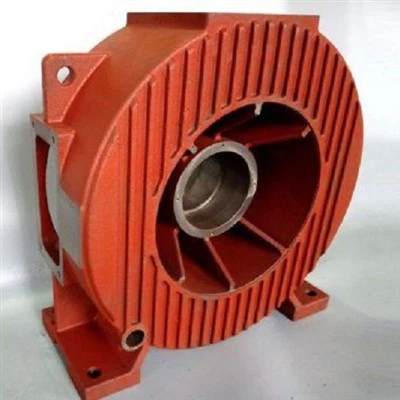
Simulation has emerged as a powerful tool in the manufacturing industry, offering a cost - effective and efficient way to optimize the design of various components. As a supplier of Grey Iron Casting Parts, I have witnessed firsthand the transformative impact of simulation on the design process. In this blog, I will delve into how we can use simulation to improve the design of Grey Iron Casting Parts.
Understanding Grey Iron Casting
Grey iron is a type of cast iron that contains graphite flakes. These flakes give grey iron its characteristic grey color when fractured. Grey iron casting is a widely used manufacturing process due to its excellent castability, good machinability, and high damping capacity. Grey Iron Casting Parts find applications in a variety of industries, including automotive, machinery, and construction. For example, in the automotive industry, grey iron is commonly used to make engine blocks, cylinder heads, and brake discs.
Grey Iron Casting Parts are produced by melting iron and pouring it into a mold. However, the casting process is complex and can be prone to defects such as porosity, shrinkage, and cracking. These defects can compromise the quality and performance of the final product. This is where simulation comes in.
The Role of Simulation in Grey Iron Casting Design
Simulation allows us to predict and analyze the behavior of the casting process before the actual production. By using computer - based models, we can simulate the flow of molten metal, the solidification process, and the formation of defects. This enables us to identify potential problems early in the design stage and make necessary adjustments to improve the casting quality.


One of the key advantages of simulation is that it can reduce the number of physical prototypes. Traditional design methods often rely on trial - and - error, which can be time - consuming and expensive. With simulation, we can test different design concepts virtually, saving both time and resources.
Types of Simulation for Grey Iron Casting
1. Fluid Flow Simulation
Fluid flow simulation is used to analyze the flow of molten metal in the mold. It helps us understand how the metal fills the mold cavity and whether there are any areas of poor filling or turbulence. By simulating the fluid flow, we can optimize the gating and riser system design. The gating system is responsible for directing the molten metal into the mold, while the riser system provides additional metal to compensate for shrinkage during solidification.
For example, if the simulation shows that the molten metal is not flowing evenly in the mold, we can adjust the size and shape of the gates and runners to ensure a more uniform filling. This can help prevent defects such as cold shuts and misruns.
2. Solidification Simulation
Solidification simulation focuses on the cooling and solidification process of the molten metal. As the metal cools, it undergoes a phase change from liquid to solid. During this process, shrinkage occurs, which can lead to the formation of porosity and shrinkage cavities.
Solidification simulation allows us to predict the location and size of these defects. We can then modify the design of the casting or the cooling conditions to minimize shrinkage. For instance, we can add chills or insulating materials to control the cooling rate and promote directional solidification.
3. Stress and Deformation Simulation
Stress and deformation simulation is used to analyze the internal stresses and deformations that occur during the casting process. When the metal solidifies, it contracts, and if the contraction is not uniform, it can lead to internal stresses. These stresses can cause cracking or warping of the casting.
By simulating the stress and deformation, we can identify areas of high stress and take measures to relieve them. This may involve changing the shape of the casting, adding ribs or fillets, or adjusting the cooling rate.
Case Study: Using Simulation to Improve a Grey Iron Casting Part
Let's consider a case where we were designing a Grey Cast Iron Products for an industrial application. The part was a large - scale component with complex geometry, and we wanted to ensure its quality and performance.
We started by creating a 3D model of the part and setting up a simulation of the casting process. The fluid flow simulation showed that there were some areas in the mold where the molten metal was not filling properly. We adjusted the gating system design by increasing the size of the runners and adding additional gates.
The solidification simulation revealed that there were potential shrinkage cavities in certain regions of the part. To address this, we added chills to these areas to promote faster cooling and reduce shrinkage.
The stress and deformation simulation indicated that there were high - stress regions in the part. We modified the shape of the part by adding fillets and ribs to distribute the stress more evenly.
After making these design changes based on the simulation results, we ran the simulation again. The second simulation showed significant improvements in the filling, solidification, and stress distribution. We then produced a physical prototype, and the results were consistent with the simulation predictions. The part had fewer defects and better mechanical properties.
Benefits of Using Simulation for Grey Iron Casting Design
1. Cost Savings
By reducing the number of physical prototypes and minimizing the occurrence of defects, simulation can lead to significant cost savings. We can avoid the expenses associated with rework, scrap, and tooling modifications.
2. Improved Quality
Simulation allows us to optimize the design of Grey Iron Casting Parts, resulting in higher - quality products. The parts are more likely to meet the required specifications and have better mechanical properties.
3. Faster Time to Market
With simulation, we can speed up the design process. We can quickly test different design concepts and make decisions based on the simulation results. This reduces the time it takes to bring a new product to the market.
How to Implement Simulation in Grey Iron Casting Design
1. Select the Right Simulation Software
There are several simulation software packages available in the market, each with its own features and capabilities. When selecting a software, we need to consider factors such as the complexity of the casting process, the accuracy of the simulation results, and the ease of use.
2. Build an Accurate Model
To get reliable simulation results, we need to build an accurate 3D model of the casting part and the mold. The model should include all the relevant details, such as the geometry, material properties, and boundary conditions.
3. Validate the Simulation Results
It is important to validate the simulation results by comparing them with experimental data. We can produce a small number of physical prototypes and measure the actual properties of the castings. If there are significant discrepancies between the simulation and the experimental results, we need to adjust the simulation model.
Conclusion
Simulation is a powerful tool that can significantly improve the design of Grey Iron Casting Parts. By using simulation, we can predict and analyze the casting process, identify potential problems, and make informed design decisions. This leads to cost savings, improved quality, and faster time to market.
As a supplier of Grey Iron Casting Parts, we are committed to using the latest simulation technologies to provide our customers with high - quality products. If you are in the market for Grey Iron Casting Parts, we invite you to contact us for a consultation. We can work together to optimize the design of your parts and ensure their performance and reliability.
References
- Campbell, J. (2003). Casting. Butterworth - Heinemann.
- Dantzig, J. A., & Tobias, S. A. (2002). Design for Manufacture. McGraw - Hill.
- Kalpakjian, S., & Schmid, S. R. (2008). Manufacturing Engineering and Technology. Pearson Prentice Hall.