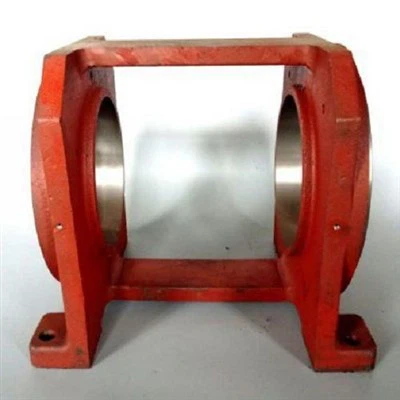
Grey iron casting parts are widely used in various industries due to their excellent properties such as high damping capacity, good machinability, and relatively low cost. The microstructure of grey iron plays a crucial role in determining its properties, and understanding this relationship is essential for producing high - quality casting parts. As a supplier of grey iron casting parts, I am often asked about how the microstructure affects the performance of these products. In this blog, I will explore this topic in depth.
Microstructure of Grey Iron
Grey iron is characterized by its graphite flakes embedded in a ferrite - pearlite matrix. The formation of graphite flakes during solidification is a result of the carbon present in the iron. When the melt cools, carbon atoms diffuse and form graphite crystals. The matrix structure, either ferrite, pearlite, or a combination of both, depends on the cooling rate and the chemical composition of the iron.
Ferrite is a relatively soft and ductile phase. It is a solid solution of carbon in alpha - iron. Pearlite, on the other hand, is a lamellar structure composed of alternating layers of ferrite and cementite (Fe₃C). The cementite is a hard and brittle phase. The ratio of ferrite to pearlite in the matrix significantly impacts the overall properties of grey iron casting parts.
Influence on Strength and Hardness
The strength and hardness of grey iron casting parts are directly related to their microstructure. The graphite flakes in grey iron act as stress concentrators. When a load is applied to the casting, these flakes can initiate cracks, which reduces the tensile strength of the material compared to other cast irons like ductile iron.
- Pearlite Matrix: A casting with a predominantly pearlite matrix has higher strength and hardness. The lamellar structure of pearlite resists deformation better than ferrite. In applications where high strength is required, such as Cast Iron Gearbox Housing, a higher proportion of pearlite in the microstructure is desirable. The cementite in pearlite contributes to the increased hardness, which helps in withstanding the mechanical stresses and wear in gearbox operation.
- Ferrite Matrix: Ferritic grey iron is softer and more ductile. It is suitable for applications where a high degree of machinability is required. Although the tensile strength is lower compared to pearlitic grey iron, the ductility provides some resistance to cracking under certain conditions. For example, in some small - scale UCP Bearing Housing parts, a ferritic or ferritic - pearlitic microstructure may be preferred to ensure ease of machining and some flexibility in assembly.
Impact on Damping Capacity
One of the most significant advantages of grey iron is its high damping capacity. Damping capacity refers to the ability of a material to dissipate mechanical energy in the form of heat when subjected to vibration or dynamic loading.
The graphite flakes in grey iron are the key to its excellent damping properties. When a vibration is applied to the casting, the graphite flakes act as internal friction sources. As the material deforms, the graphite flakes slide and rub against the surrounding matrix, converting the mechanical energy of vibration into heat.
A finer distribution of graphite flakes generally leads to better damping capacity. In a well - controlled microstructure, the small graphite flakes can more effectively absorb and dissipate the vibration energy. This property makes grey iron an ideal material for applications where vibration reduction is critical, such as machine tool bases and engine blocks. Our Grey Cast Iron Products are designed to have an optimized graphite structure to provide superior damping performance.
Machinability
The machinability of grey iron casting parts is also closely related to their microstructure. Machinability refers to the ease with which a material can be cut, shaped, and finished using machining processes such as turning, milling, and drilling.


- Graphite Flakes: The graphite flakes in grey iron act as built - in lubricants during machining. As the cutting tool passes through the material, the graphite flakes break off and help to reduce friction between the tool and the workpiece. This results in lower cutting forces, reduced tool wear, and better surface finish. A larger and more well - spaced distribution of graphite flakes generally improves machinability.
- Matrix Structure: A ferritic matrix is more machinable than a pearlitic matrix. Ferrite is softer and easier to cut, which reduces the power requirements for machining operations. However, a balance needs to be struck between machinability and other properties such as strength. For many of our grey iron casting parts, we aim to achieve a microstructure that combines good machinability with sufficient strength for the intended application.
Thermal Conductivity
Thermal conductivity is an important property for applications where heat transfer is critical, such as in heat exchangers or engine components. The microstructure of grey iron has a significant impact on its thermal conductivity.
The graphite flakes in grey iron are good conductors of heat. The high thermal conductivity of graphite allows heat to transfer more easily through the material. In a casting with a well - distributed graphite structure, the heat can flow along the graphite flakes, enhancing the overall thermal conductivity.
However, the matrix structure also plays a role. Ferrite has a relatively high thermal conductivity compared to pearlite. A ferritic or ferritic - pearlitic grey iron generally has better thermal conductivity than a fully pearlitic one. In applications where efficient heat dissipation is required, we can optimize the microstructure of our grey iron casting parts to enhance thermal conductivity.
Corrosion Resistance
The corrosion resistance of grey iron casting parts is influenced by their microstructure. The graphite flakes in grey iron can act as cathodes, while the iron matrix acts as an anode in a corrosion cell. This can lead to preferential corrosion of the iron matrix around the graphite flakes.
- Graphite Morphology: A coarser graphite structure may be more prone to corrosion compared to a finer one. The larger graphite flakes expose more surface area of the iron matrix to the corrosive environment, increasing the likelihood of corrosion.
- Matrix Structure: A pearlitic matrix may offer better corrosion resistance than a ferritic one in some cases. The cementite in pearlite is more resistant to corrosion, and the lamellar structure can provide some protection to the underlying ferrite. However, the overall corrosion resistance of grey iron is relatively limited compared to some other metals and alloys, and appropriate surface treatments may be required for applications in harsh environments.
Controlling the Microstructure
As a supplier of grey iron casting parts, we have developed various techniques to control the microstructure of our products to meet the specific requirements of our customers.
- Chemical Composition: Adjusting the chemical composition of the grey iron is one of the most effective ways to control the microstructure. Elements such as carbon, silicon, manganese, sulfur, and phosphorus can all influence the formation of graphite flakes and the matrix structure. For example, increasing the carbon content generally promotes the formation of graphite flakes, while silicon can enhance graphitization and also affect the matrix structure.
- Cooling Rate: The cooling rate during solidification is another critical factor. A faster cooling rate can result in a finer graphite structure and a higher proportion of pearlite in the matrix. We use different casting processes and mold materials to control the cooling rate and achieve the desired microstructure.
- Heat Treatment: Heat treatment can also be used to modify the microstructure of grey iron casting parts. Annealing can be used to increase the proportion of ferrite in the matrix, improving machinability. Normalizing can refine the microstructure and increase strength and hardness.
Conclusion
In conclusion, the microstructure of grey iron casting parts has a profound influence on their properties, including strength, hardness, damping capacity, machinability, thermal conductivity, and corrosion resistance. As a supplier, we understand the importance of controlling the microstructure to produce high - quality casting parts that meet the diverse needs of our customers.
Whether you are looking for UCP Bearing Housing, Cast Iron Gearbox Housing, or other Grey Cast Iron Products, we have the expertise and technology to provide you with the best - suited products. If you are interested in our grey iron casting parts, please feel free to contact us for procurement discussions. We are committed to working with you to find the optimal solutions for your applications.
References
- Campbell, J. (2003). Castings. Butterworth - Heinemann.
-ASM Handbook Committee. (2008). ASM Handbook, Volume 15: Casting. ASM International. - Totten, G. E., & MacKenzie, D. S. (2003). Handbook of Aluminum Alloy Castings: Properties, Processes, and Applications. ASM International.